What Is Identity? Who Gets to Define It? Finding Your Answer in the Empty Nest Season.

Every conference begins the same way.
You walk in, grab a lanyard, and write your name.
But what you write on that badge says more than your name.
It says who you believe you are.
We write: Teacher. CEO. Mom. Retired. Cancer survivor. Widow. Successful. Divorced. Empty nester.
But Scripture says something different.
Last week, we asked a quiet but important question:
Who am I now?
When the roles shift, the calendar softens, and the house grows quiet. That question rises to the surface. But before we can answer it honestly, we need to step back and define something more fundamental.
What do we mean by identity?
Identity is the settled understanding of who you are at your core — the truth you live from regarding your worth, belonging, and purpose.
It is the internal answer to three questions:
Who am I?
Whose am I?
Where do I belong?
Whether we articulate it clearly or not, each of us lives by some definition. The question is not whether we have one. The question is whether it is true — and whether it is anchored in something stable.
Identity Begins with Being, Not Doing
Scripture introduces identity not with performance, but with origin.
In Genesis 1:26–27, humanity is described as created in the image of God. Before work is assigned, before families are formed, and before anything is achieved.
Image comes first.
At its most basic level, identity is rooted in being created by God and bearing His image. It is not something earned. It is something given.
We see this pattern again in Matthew 3:17, when Jesus is baptized. Before His public ministry begins, before any miracles or teaching of crowds, a voice from heaven declares:
“This is my beloved Son, with whom I am well pleased.”
Beloved precedes performance.
If that pattern holds for Christ, it reveals something profound about us. Identity is declared before it is demonstrated.
What Identity Is Not
Because identity is foundational, it is easy to confuse it with things that are important but temporary.
Identity is not:
Your role (parent, spouse, professional)
Your productivity
Your personality
Your current season of life
Other people’s opinion of you
Even your specific calling in a given season
Roles are meaningful. Calling matters. Seasons shape us.
But they are not the core.
Roles are assignments. Identity is essence.
This distinction becomes especially important during seasons of transition. When roles shift, if identity was fused with them, the shift can feel like a loss of self.
But biblically speaking, identity precedes role. It is deeper than assignment.
Where Identity Typically Comes From
If identity is the settled truth we live from, where does that truth get formed?
Often from voices and experiences that feel authoritative at the time.
Family narratives.
“You’re the responsible one.”
“You’re the strong one.”
“You’re the quiet one.”
Achievement and failure.
Success reinforces worth.
Failure questions it.
Cultural messaging.
Productivity equals value.
Youth equals relevance.
Independence equals strength.
Pain and survival.
Control becomes identity.
Self-reliance becomes identity.
Being needed becomes identity.
These sources are powerful because they are repeated. They shape how we interpret ourselves and the world.
But they are not ultimate.
The Problem with Unreliable Sources
When identity is built primarily on unstable sources, instability follows.
If worth is tied to productivity, retirement can feel threatening.
If belonging is tied to being needed, the empty nest feels like erasure.
If value is tied to strength, aging feels like diminishment.
Identity confusion is not merely emotional fragility. It often stems from misplaced authority — allowing voices with limited perspective to define what only the Creator has the right to declare.
In Genesis 3, the first fracture in human identity begins with a question: “Did God really say?” A competing voice challenges the Author. The result is confusion, shame, and hiding.
When the wrong voice defines us, instability ensues.
The Case for Letting God Define You

You are one among many. Similar… but not identical. Unique. Irreplaceable. Inimitable.
If identity begins in creation, then the Creator has authorship.
The One who forms has the authority to name.
Scripture consistently affirms this. In Ephesians 1, Paul describes believers as chosen, adopted, and sealed — not because of their performance but because of God’s initiative.
“He chose us before the foundation of the world”
Identity is received before it is lived.
This does not remove responsibility. It clarifies the foundation.
When God defines you:
Worth is not seasonal.
Belonging is not conditional.
Purpose is not dependent on applause.
The question is not whether you will live by a definition. You will. The question is whose definition you will trust.
Why This Matters in the Empty Nest Season
In this season of life, many of the external witnesses grow quieter.
The daily affirmation of being needed changes.
The urgency shifts.
The calendar looks different.
If identity were built on constant usefulness, quiet could feel disorienting.
But if identity is anchored in something deeper — in being created, known, declared, and called by God — then the quiet becomes spacious rather than threatening.
The empty nest does not remove identity. It reveals its foundation.
You are not less because your role has changed.
You are not diminished because your season has shifted.
You are still image-bearing.
Still known.
Still declared beloved.
And if God is the Author, then this chapter of your life is not an afterthought. It is part of a story still being written.
A Simple Reflection

This week…
Consider asking yourself:
What voices have most shaped how I see myself?
Which of those voices are temporary — and which are rooted in Scripture?
Write this sentence and sit with it: “My identity is ultimately defined by…”
Let Scripture, not circumstance, complete the sentence.
Next week…
We will explore one of the most common substitutes for identity: performance and achievement. Why do they so easily become our definition?
For now, rest in this:
Identity is not something you build through effort.
It is something you receive — first in creation, and more fully in Christ.
And the One who defines you has not changed.
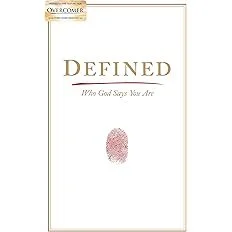
Defined: Who God Says You Are Hardcover –
by Stephen Kendrick and Alex Kendrick
This page contains affiliate links. If you choose to purchase after clicking a link, we may receive a commission at no extra cost to you.
Please share this post with a friend and ask them to follow/like/subscribe on the social platforms below to help me spread my content! Thanks! I appreciate your support!