Empty Nest Lens: The Control Trap

Sometimes peace begins when we stop gripping the future and start trusting the One who already holds it.
When Managing Everything Becomes Exhausting
🌿 Overview
The empty nest season often brings a strange kind of uncertainty — especially when identity itself begins to feel unsettled.
Not always dramatic.
Just unfamiliar.
The routines change. The noise fades. The roles shift.
And suddenly, life contains more variables you can no longer manage the way you once did.
Your children make decisions without you. Relationships evolve. Parents age. Health changes. Finances matter more. The future feels less predictable.
And somewhere in the middle of all that, many people begin holding tighter.
Not necessarily because they are controlling people.
But because control can feel safer than uncertainty.
Especially after seasons where life felt painful, unstable, disappointing, or emotionally overwhelming.
Sometimes control becomes the quiet promise we make to ourselves:
If I can just manage everything carefully enough… maybe I can prevent more pain.
But over time, that constant need to manage, anticipate, fix, monitor, and prepare becomes exhausting.
Because control was never meant to carry the weight of security.
Peace was never meant to depend on your ability to manage every outcome.
The control trap begins when peace becomes dependent on your ability to manage outcomes.
And slowly, without realizing it, control begins shaping identity.
You start feeling valuable when:
things are organized
plans stay intact
risks stay minimized
uncertainty stays manageable
emotions stay contained
But underneath the surface, control is often less about strength…
and more about fear.
Fear of disappointment, helplessness, chaos, vulnerability, loss, failure, or being caught unprepared.
And eventually, the need to control everything begins controlling you.
📖 Capstone Verse
“Be still, and know that I am God.”
— Psalm 46:10
📖 Scripture Addresses This Directly
Psalm 46 was not written during a peaceful season.
It was written in the middle of instability.
Threats.
Fear.
Uncertainty.
And into that environment, God does not say:
Work harder to hold everything together.
He says:
“Be still”
Not because circumstances are easy.
But because He remains steady even when life is not.
The invitation of Scripture is not passive irresponsibility.
It is releasing the illusion that your safety ultimately depends on your ability to control every outcome.
🪞How the Control Trap Forms
Control usually develops honestly.
Responsibility becomes vigilance.
Wisdom becomes hyper-awareness.
Preparation becomes anxiety.
And over time, what once felt helpful quietly becomes emotionally consuming.
Many people learned early in life that staying alert helped them feel safe.
Maybe unpredictability surrounded you.
Maybe emotions in the home felt unstable.
Maybe mistakes carried consequences.
Maybe peace only existed when everything stayed “under control.”
So you adapted.
You became dependable.
Prepared.
Responsible.
Capable.
And those are not bad qualities.
But somewhere along the way, peace stopped coming from trust…
and started coming from management.
🧰 What Control Was Never Meant To Do
Looking back, I still marvel at what Josena and I were able to accomplish during those busy years.
We both had demanding careers that rarely fit neatly into a schedule.
At the same time, we were building our family through adoption—one child through a domestic adoption and another from China.
Life often felt like a constant balancing act.
Work responsibilities, school activities, travel, appointments, finances, church, family, friendships.
And somehow, by God's grace, we kept moving forward.
During those years, control was not the enemy.
In many ways, it was a useful tool.
We use control—or at least the illusion of it—to organize, prioritize, and manage situations that can spiral quickly if left unattended.
Control helps us create order from complexity.
It helps us solve problems.
Make plans.
Protect what matters.
Carry responsibility well.
Used wisely, control can be an expression of stewardship.
But every tool has limits.
Eventually, the season changed.
The children grew up.
They developed their own opinions, dreams, and ways of seeing the world.
Health challenges entered the picture.
Career changes arrived that we never anticipated.
Some situations could no longer be solved through effort, planning, or careful management.
And that is where many of us discover something important.
Control was never designed to carry the full weight of our security.
Because some relationships cannot be managed into health.
Some fears cannot be organized away.
Some outcomes cannot be predicted.
And some people we love must be allowed to make choices we would never make ourselves.
When control becomes the only tool we use, people often get hurt.
We become less patient.
Less flexible.
Less present.
Less trusting.
Not because we intend harm.
But because fear quietly convinces us that managing outcomes is the same thing as creating safety.
And that is often where the control trap begins.
🌊 What Control Often Sounds Like
Control rarely announces itself openly.
Usually, it disguises itself as wisdom, responsibility, or concern.
It sounds like:
“I just need to think this through one more time.”
“I’m only trying to help.”
“If I don’t stay on top of this, everything could fall apart.”
“I feel better when I know what’s happening.”
“I just wish people would make wiser decisions.”
“Why does uncertainty bother me so much?”
“I struggle when life feels out of my hands.”
And underneath all of it is often one deeper fear:
“What happens if I cannot stop painful things from happening?”
📸 A Quiet Empty Nest Moment
You check your phone again.
Not because there’s new information.
Because uncertainty feels uncomfortable.
A child hasn’t called back yet.
A situation remains unresolved.
Something in the future feels unclear.
And mentally, you begin rehearsing possibilities.
Solutions.
Contingencies.
Conversations.
You tell yourself you’re just being responsible.
But internally, you feel restless.
Tight.
Unable to settle.
Not because something terrible has happened.
Because you cannot fully control what might.
That is often how the control trap works.
Quietly.
Relentlessly.
Internally.
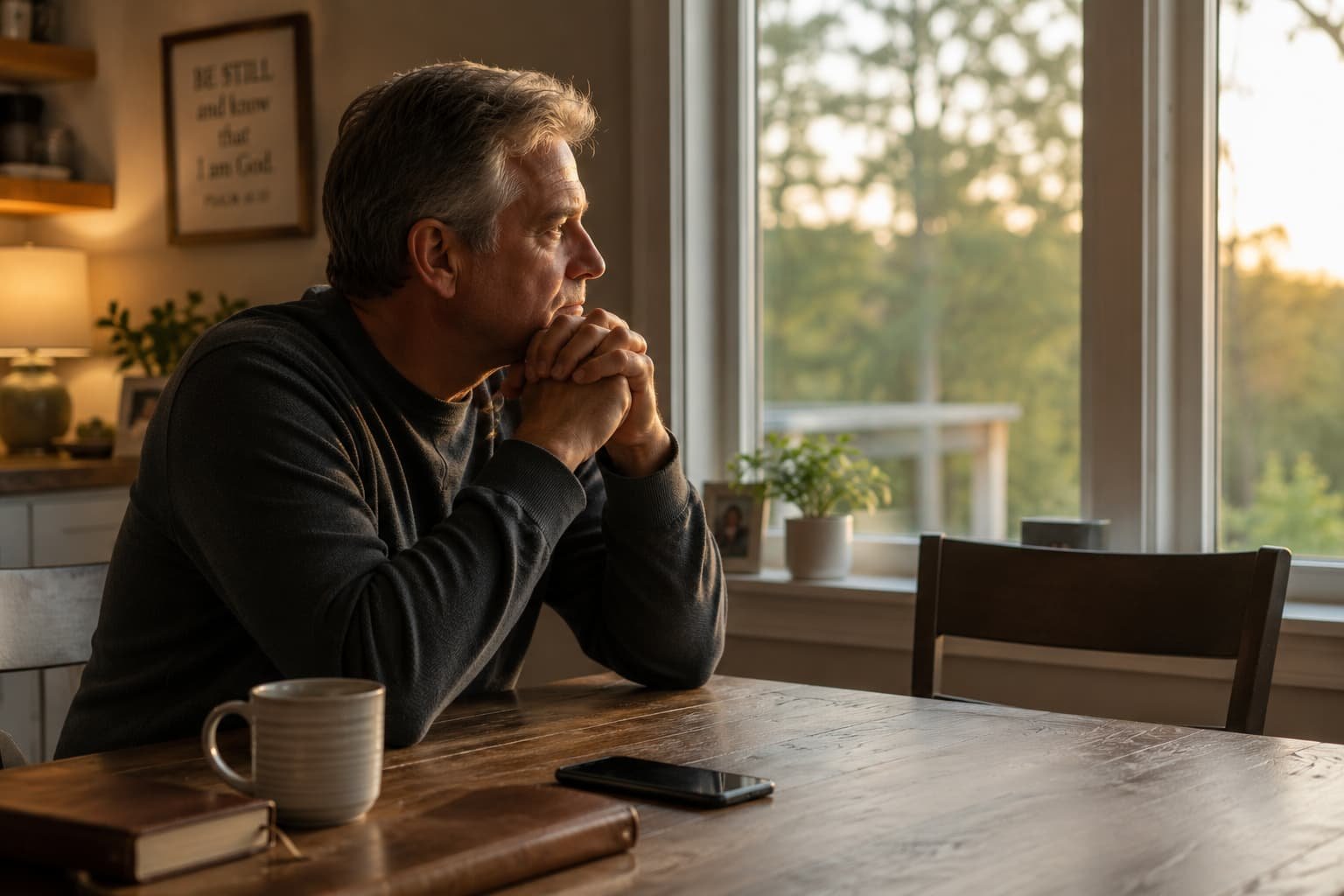
Sometimes the hardest lessons arrive when we finally see the difference between loving people and trying to manage their lives.
💔 When I Began to See the Cost
There are moments now when I look back and wonder how often I confused love with management.
I wanted good things for my children.
I wanted them to avoid pain.
Avoid mistakes.
Avoid consequences that might follow them for years.
And because I cared deeply, I often felt responsible for outcomes that were never entirely mine to control.
Looking back, I can see how exhausting that became—not only for me, but sometimes for the people around me.
One of the hardest lessons of this season has been realizing that love and control are not the same thing.
Love remains present.
Control often demands a particular outcome.
And sometimes the tighter we hold, the harder it becomes for relationships to breathe.
Some of the relationships I value most have taught me that lesson the hard way.
Looking back, I can see moments when my desire to protect people I loved sometimes made it harder for them to feel trusted.
That realization has not been easy.
But it has taught me something I am still learning today:
Trust is not giving up on people.
Trust is letting go of the belief that their future depends entirely on me.
✨ The Difference Between Wisdom and Control
Wisdom prepares.
Control obsesses.
Wisdom acts responsibly.
Control carries emotional weight never meant to belong to you.
Wisdom trusts God while taking healthy action.
Control believes peace only comes when outcomes stay manageable.
One produces steadiness.
The other produces exhaustion.
🌱 Why This Matters in the Empty Nest Season
The empty nest season exposes how much of life was never truly controllable to begin with.
And that realization can feel deeply unsettling.
Because many people built emotional security around:
solving problems
anticipating risks
managing family dynamics
But now?
The season that once rewarded careful management begins changing.
Adult children make decisions you would not necessarily make.
Grandchildren may someday be raised differently than you expected.
Retirement creates new questions with fewer clear answers.
Health concerns remind you that life is more fragile than it once seemed.
Aging parents may face situations you cannot fix.
And despite your best efforts, many of the people you love most are now living lives you can influence—but no longer control.
That reality can feel unsettling.
Not because you lack faith.
But because it exposes how much of your security may have become connected to managing outcomes.
Children build lives you cannot fully direct.
Relationships evolve independently.
Life becomes less predictable.
And without realizing it, anxiety increases because identity was partially tied to management.
But perhaps this season is also an invitation.
Not to become careless.
But to loosen your grip enough to rediscover trust.

Sometimes trust begins in the quiet places where control finally loosens its grip.
🔬 What Research Says
Researchers have long observed that uncertainty is one of the primary drivers of anxiety.
Interestingly, studies suggest that people often experience more stress from trying to eliminate uncertainty than from uncertainty itself.
Psychologists refer to this as an intolerance of uncertainty—the tendency to feel distressed when outcomes cannot be predicted or controlled.
When uncertainty rises, many people respond by increasing planning, monitoring, reassurance-seeking, or attempts to manage circumstances more closely.
While these behaviors may provide temporary relief, they often reinforce anxiety over time because the need for certainty is never fully satisfied.
Research also suggests that emotional well-being tends to improve when people learn to distinguish between what they can influence and what they cannot control.
Rather than trying to manage every outcome, healthier coping often involves accepting uncertainty while remaining engaged with what matters most.
This challenge is not limited to moments of crisis. It often appears during major life transitions as well. In From Strength to Strength, Arthur Brooks observes that many people struggle when the strengths and strategies that served them well in one season of life become less effective in another. Growth often requires learning new ways to adapt, trust, and find meaning when old methods no longer provide the same sense of security.
In many ways, this aligns with a timeless biblical principle:
Peace grows not from controlling the future, but from learning to trust amid uncertainty.
🔗 Learn More
💛 Living From the Truth
Trust is not the absence of responsibility.
It is the willingness to stop carrying responsibilities that were never yours to begin with.
You were never meant to:
control everyone’s future
prevent every hardship
anticipate every outcome
hold every relationship together
carry the emotional weight of the entire family
And exhausting yourself trying to do so will not create peace.
Sometimes trust looks less dramatic than we expect.
It may simply mean:
pausing before spiraling
resisting the need to fix every emotion
allowing others to make their own decisions
praying instead of rehearsing outcomes
choosing presence over mental management
breathing deeply enough to remember:
God is already present in the future you are afraid of.
And perhaps…
what trust looks like for you right now is smaller, quieter, and more possible than you imagined.
Real peace begins when identity is no longer rooted in being the one who holds everything together.
Because ultimately…
you were never the one holding everything together in the first place.
🌿 Small Steps Toward Trust
If the control trap has shaped your life for years, learning to trust again may not happen overnight.
Sometimes growth begins with small decisions repeated consistently over time.
Here are a few gentle ways to begin loosening the grip of control in everyday life:
Pause before immediately trying to solve every problem.
Ask yourself whether a situation truly requires action—or simply trust.
Resist rehearsing worst-case outcomes in your mind.
Practice praying before mentally managing.
Allow people you love to make choices without carrying responsibility for every result.
Trust is rarely built all at once.
More often, it grows slowly through repeated moments of release.
📚 Reflection Questions
What situations make you feel most emotionally restless or uneasy?
Where do you tend to confuse responsibility with control?
What fears tend to surface when life feels uncertain?
How much of your peace depends on outcomes staying manageable?
What would it look like to trust God more deeply in this season?
✍️ Guided Journal Prompts
“One area of life I struggle to release control over is…”
“What I fear might happen if I let go is…”
“Control makes me feel temporarily…”
“The emotional cost of constantly managing everything is…”
“What trust may look like for me right now is…”

Trust rarely arrives all at once. More often, it grows one step at a time.
🤍 Closing Thought
Control promises peace through management.
But peace was never meant to come from carrying the weight of the entire future.
And perhaps the goal of this season is not learning how to manage life more carefully.
Perhaps it is discovering that God remains faithful even when life cannot be managed.
Because peace is not found in controlling the future.
Peace is found in trusting the One who is already there.
🌿 Coming Next
Learning to loosen our grip on control is an important step.
But for many of us, control is not the deepest issue.
Often, it grows from a deeper belief:
If I don't take care of it, who will?
Over time, responsibility can quietly become self-reliance.
We carry burdens alone.
We hesitate to ask for help.
We trust our own strength more than God's provision.
And without realizing it, we begin measuring our security by our ability to handle life on our own.
The empty nest season has a way of exposing those habits.
Some challenges cannot be solved through effort alone.
Some burdens were never ours to carry by ourselves.
And some seasons invite us to trust God in ways we never needed to before.
In our next Empty Nest Lens article, we'll explore how self-reliance shapes identity—and how God invites us to exchange striving for dependence on Him.
Coming Next: The Self-Reliance Trap | When Strength Quietly Becomes Emotional Isolation
Next Steps:
If this resonated with you, you may also relate to:
• The Approval Trap.
• The Performance Trap.
• The Role Trap.
Or:
👉 Sign up to receive the Purpose Reset Guide
👉 Share this with a friend who may need encouragement