Empty Nest Lens: The Self-Reliance Trap

Sometimes the strongest people carry the heaviest burdens alone.
When Strength Quietly Becomes Emotional Isolation
For much of my life, self-reliance felt responsible.
At the time, none of that felt unhealthy.
It felt responsible.
Necessary.
Mature.
Strong.
And honestly, much of it was rewarded.
That mindset followed me into my career, graduate school, leadership, family life, and eventually even into writing these blogs.
If a group project was falling apart, I finished your section, too.
If something needed fixing, I fixed it.
If something needed to be carried, I carried it.
If something felt uncertain, I worked harder.
And over time, something subtle began to happen beneath all that responsibility.
I stopped asking for help.
I stopped letting people see when life felt heavy.
I learned how to carry difficult things privately.
Not because I was arrogant.
But because somewhere along the way, depending on others stopped feeling emotionally safe.
So I adapted.
I became the dependable one.
The steady one.
The capable one.
Sometimes it honestly felt easier to carry everything myself than risk disappointment, misunderstanding, or being let down.
For some of us, that pattern forms early.
Responsibility slowly becomes identity.
Competence quietly becomes emotional protection.
And eventually, strength becomes the place we learn to survive.
The difficult part is that self-reliance rarely looks destructive at first.
In fact, it often looks admirable.
People trust you.
Depend on you.
Respect you.
But eventually, the body and soul begin carrying weight they were never meant to hold indefinitely.
And for many people, the empty nest becomes the season where that hidden exhaustion finally becomes visible.
Because when life grows quieter, there are fewer distractions from what has been happening underneath the surface for years.
The schedules slow.
The roles shift.
The noise decreases.
Adult children need you differently.
Careers begin changing.
Retirement edges closer.
And many people discover how much of their identity was built around carrying, managing, fixing, and staying strong for everyone else.
When those roles begin loosening their grip, the question becomes:
Who am I when I am no longer carrying everyone else?
That realization can feel deeply unsettling.
Especially when you have spent decades believing:
“If things are going to be okay…
it’s mostly up to me.”
🌱 📖 Capstone Verse
“Trust in the Lord with all your heart
and lean not on your own understanding;
in all your ways submit to Him,
and He will make your paths straight.”
— Proverbs 3:5–6
🌱 The Tension Beneath the Strength
One of the quiet tensions throughout Scripture is the difference between strength and dependence.
The book of Proverbs was written to teach wisdom — not merely competence, intelligence, or responsibility, but trust.
And that makes Proverbs 3 deeply personal for many self-reliant people.
Because self-reliance often sounds wise internally.
“Handle it yourself.”
“Stay strong.”
“Don’t burden anyone.”
“I’ll figure it out.”
And for a long time, those patterns may have genuinely helped us survive difficult seasons.
But eventually I began confronting something uncomfortable:
I did not simply have a workload problem.
I had a trust problem.
Not:
“Do I believe in God?”
But:
“Do I trust God enough to stop carrying everything myself?”
That is a much deeper question.
Because many self-reliant people love God sincerely…
while emotionally carrying life as though everything still depends upon them.
🌱 The Hidden Cost of Carrying Everything
And over time, that way of living becomes exhausting.
Not just emotionally.
Physically as well.
I began noticing something strange in my own life.
I was often “fine” when responsibility demanded it…
and exhausted the moment life slowed down.
Many days, I felt like warmed-over death.
I could push through work obligations.
Carry pressure.
Show up for everyone else.
But when the weekends came…
when the pace quieted…
I realized how little margin I actually had left, emotionally, physically, and spiritually.
Sometimes I was too depleted to fully enjoy the people I loved most.
And slowly, I had to confront something painful:
I thought I was protecting everyone by carrying everything myself.
I did not realize how much of me slowly disappeared underneath the weight.
And maybe even harder than that…
I began to realize that the people closest to me had experienced the effects of that exhaustion, too.
Not because love was absent.
But because survival quietly took over.
And perhaps that is the part no one talks about:
Self-reliance often gets rewarded long before its emotional cost becomes visible.
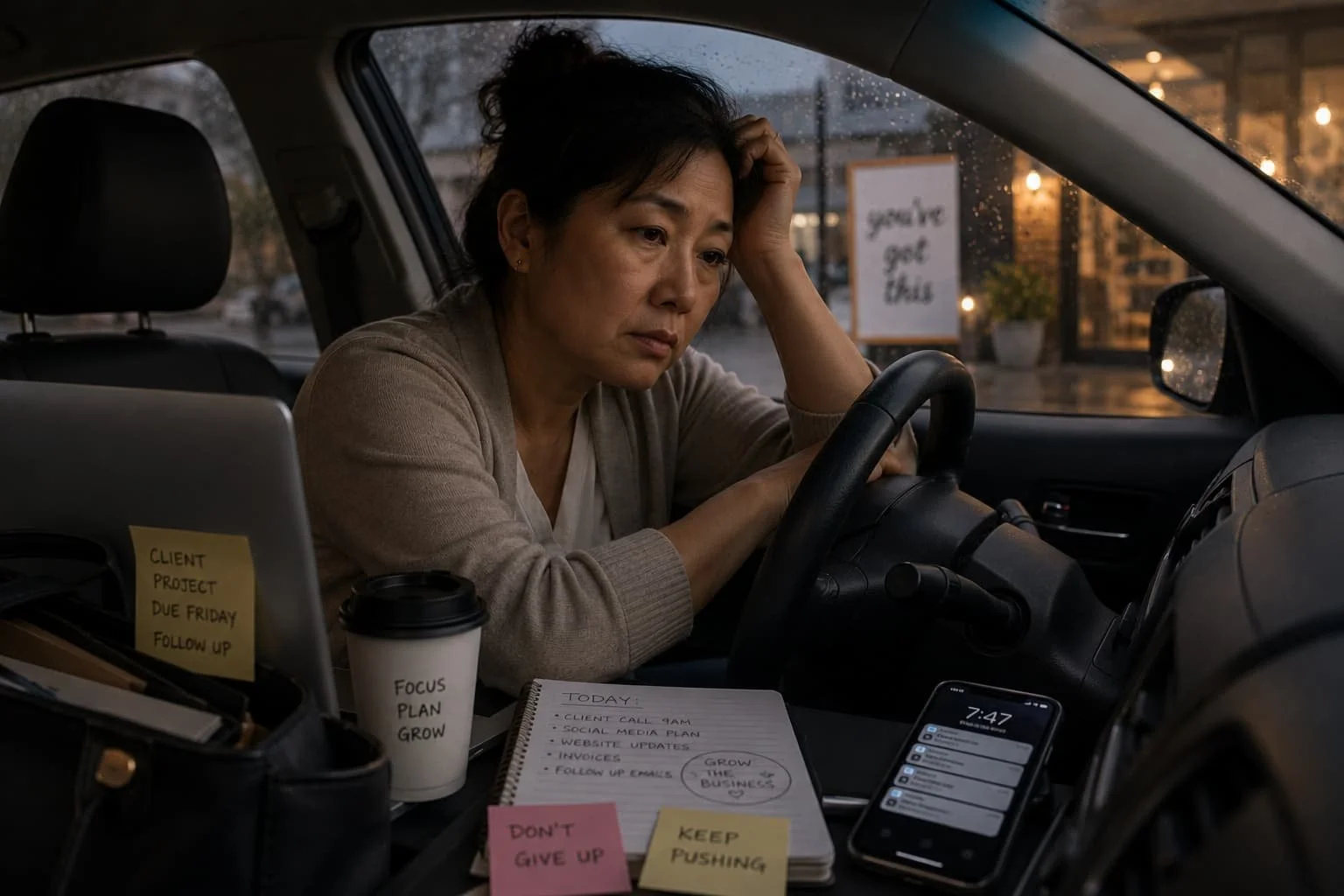
When everything feels like it depends on you, rest can start feeling unsafe.
That is where the Self-Reliance Trap begins.
The Self-Reliance Trap
rarely begins with pride.
More often than not, it begins with survival.
Maybe vulnerability felt unsafe early in life.
Maybe emotions were ignored, criticized, or dismissed.
Maybe reliability became the only way you felt valuable.
Or maybe life simply required you to become strong faster than you should have needed to.
So you adapted.
You became competent.
Independent.
Emotionally contained.
And honestly?
Those patterns probably helped you survive.
For many people, responsibility slowly becomes connected to identity itself — something explored more deeply in The Role Trap.
And for others, being dependable becomes connected to acceptance, affirmation, or emotional safety — a pattern closely tied to The Approval Trap.
So you carry more.
More responsibility.
More pressure.
More emotional weight.
Quietly.
You become the safe person.
The reliable person.
The one everyone assumes will be okay.
And externally, that may even look admirable.
But internally, something else slowly begins happening.
You stop sharing honestly.
You stop reaching out when life feels heavy.
You become uncomfortable needing support yourself.
Because underneath many self-reliant people is a deeper fear:
“If I stop holding everything together…
what happens then?”
Especially in the empty nest season.
Because stillness has a way of exposing what constant movement once helped us avoid.
And for many self-reliant people, the empty nest becomes the first season where they realize something difficult:
They know how to care for others far better than they know how to receive care themselves.
So even while surrounded by people who love them…
they continue carrying life internally and alone.
You may notice:
difficulty admitting loneliness,
feeling uncomfortable needing emotional support,
avoiding conversations about fear or exhaustion,
minimizing your own needs,
or feeling guilty while resting.
The trap is not strength itself.
The trap is believing your worth, safety, or stability depends entirely upon your ability to carry life alone.

Healing sometimes begins the moment we realize we were never meant to carry life alone.
Healing from the Self-Reliance Trap
Healing begins when we realize:
We do not lose strength by allowing support into our lives or becoming passive, irresponsible, or weak.
It means learning the difference between strength and surrender.
Healthy dependence is not weakness.
In fact, Scripture repeatedly teaches that surrender to God produces the deepest kind of strength.
Not frantic strength.
Not performative strength.
Not exhausting strength.
Steady strength.
The kind rooted in trust instead of control.
The goal is not to shame the strength that carried you through difficult seasons.
Some of those survival patterns protected you when life genuinely felt hard.
But eventually, survival patterns no longer create peace.
And the empty nest may become the very season where God begins inviting you into something different:
Rest instead of constant pressure.
Honesty instead of emotional hiding.
Connection instead of isolation.
Trust instead of carrying everything alone.
🌱 Small Steps Toward Trust
Healing from self-reliance rarely happens through one dramatic decision.
More often, it begins through small acts of trust practiced consistently over time.
You might:
Ask for help before reaching the point of exhaustion.
Share a struggle with a trusted friend instead of carrying it privately.
Accept support without immediately feeling obligated to repay it.
Pray honestly about what feels overwhelming instead of pretending you are fine.
Allow yourself to rest without believing everything depends upon you.
None of these actions eliminate responsibility.
They simply remind us that responsibility was never meant to become isolation.
For many people, healing begins very quietly.
Sometimes it looks like:
asking for help honestly,
admitting exhaustion instead of minimizing it,
allowing trusted people to support you emotionally,
praying honestly instead of pretending you are okay,
learning to sit still without immediately trying to fix or carry something,
or allowing yourself to receive care without feeling guilty for needing it.
Sometimes healing begins by building relationships before crisis forces vulnerability.
Sometimes it begins by resting before the body demands it.
Sometimes it begins by finally admitting:
“I cannot carry this alone anymore.”
And slowly, over time, many people begin discovering something surprising:
Peace often grows in the places where self-reliance once ruled.

Trust often begins quietly, long before life fully feels settled.
God never asked you to carry alone what grace was always meant to help hold.
🤍 A Gentle Reframe
What if strength is not:
never needing help…
but finally feeling safe enough to receive it?
What if maturity is not:
holding everything together…
but learning who can hold you when life feels heavy?
And what if this season is not exposing weakness…
but inviting deeper trust?
Because perhaps the goal was never independence at all.
Perhaps the deeper invitation was always relationship:
with God,
with others,
and with the parts of ourselves we learned to hide beneath constant strength.
🌿 Why This Series Matters
Many people enter the empty nest believing their struggle is simply about change.
But often, this season reveals deeper identity patterns that were quietly formed over decades.
The goal of this series is not shame.
It is awareness.
Because what remains hidden often continues shaping us without our understanding.
And sometimes the very places where we learned to survive become the places where God now invites healing.
📓 Reflection Questions
When did I first begin believing I had to carry life mostly alone?
What situations make it hardest for me to ask for help?
Do I allow trusted people to see my struggles honestly?
What fears surface when I imagine depending on God more deeply?
Where has self-reliance quietly become emotional isolation?
What would healthy trust look like in this season?
✍️ Guided Journal Prompts
Describe a season when you felt you had to become “the strong one.”
What emotions do you tend to carry privately?
In what ways has independence protected you?
In what ways has it isolated you?
What would it look like to receive support more honestly?
Write a prayer releasing one burden you have been carrying alone.
🙏 Closing Prayer
Lord,
I am tired of carrying burdens You never asked me to carry alone.
Teach me the difference between strength and self-protection.
Help me trust You more deeply instead of depending only upon myself.
Give me the courage to be honest, vulnerable, and open to support.
Heal the places where fear taught me to hide behind independence.
And remind me again that surrender is not weakness.
Your strength is enough for this season.
Amen.
📚 Research & Reading
This article was informed by research and writing related to identity formation, attachment theory, emotional regulation, burnout, chronic stress, vulnerability, connection, and the ways self-protective patterns can shape relationships over time.
Additional themes explored include emotional safety, trust, survival-based coping patterns, spiritual dependence, and the impact of emotional isolation during major life transitions such as the empty nest season.
🌿 Coming Next in the Identity Series
Sometimes the reason we carry everything alone isn't that we're strong.
It's because we're afraid.
Afraid of being exposed.
Afraid of disappointing others.
Afraid that if people saw our weaknesses, they might see us differently.
In the next article, we'll explore:
The Shame Trap
When hidden wounds quietly shape our identity—and how God's grace invites us to step out of hiding.
📚 Citations & Resources
The ideas explored in this article draw on research and writing on vulnerability, emotional health, identity formation, healthy relationships, spiritual dependence, and the impact of chronic self-reliance on emotional well-being.
(Some links may be affiliate links. We only recommend what we trust.)
Brené Brown — Daring Greatly
Henry Cloud & John Townsend — Boundaries
Curt Thompson — The Soul of Shame
Timothy Keller — The Freedom of Self-Forgetfulness
National Institute of Mental Health — Caring for Your Mental Health
Scripture quotations are from the Holy Bible, New International Version (NIV).✨
🌿 Continue the Journey
Explore the other Identity Series articles and reflection resources designed to help empty nesters rediscover identity, purpose, connection, and faith during seasons of transition.